
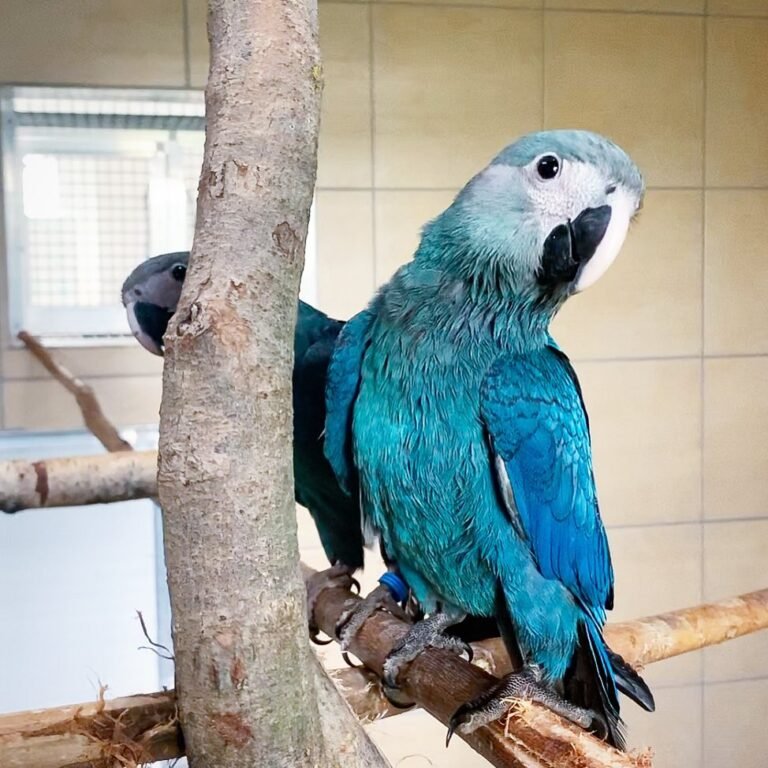

Spix’s Macaw Parrots For Sale | Spix’s Macaw Parrots Australia
Spix’s macaw (Cyanopsitta spixii), also known as the little blue macaw, or just blue macaw, is a macaw species that was endemic to Brazil. It is a member of tribe Arini in the subfamily Arinae (Neotropical parrots), part of the family Psittacidae (the true parrots). It was first described by German naturalist Georg Marcgrave, when he was working in the State of Pernambuco, Brazil in 1638 and it is named for German naturalist Johann Baptist von Spix, who collected a specimen in 1819 on the bank of the Rio São Francisco in northeast Bahia in Brazil. This bird has been completely extirpated from its natural range, and following a several-year survey, the IUCN officially declared it extinct in the wild in 2019. However, after over 20 years of conservation efforts, 200 macaws have been bred from just two parent birds, and 52 individual birds have since been reintroduced into their natural environment in June 2022.
The bird is a medium-size parrot weighing about 300 grams (11 oz), smaller than most of the large macaws. Its appearance is various shades of blue, with a grey-blue head, light blue underparts, and vivid blue upperparts. Males and females are almost identical in appearance; however, the females are slightly smaller.
The species inhabited riparian Caraibeira (Tabebuia aurea) woodland galleries in the drainage basin of the Rio São Francisco within the Caatinga dry forest climate of interior northeastern Brazil. It had a very restricted natural habitat due to its dependence on the tree for nesting, feeding and roosting. It feeds primarily on seeds and nuts of Caraiba and various Euphorbiaceae (spurge) shrubs, the dominant vegetation of the Caatinga. Due to deforestation in its limited range and specialized habitat, the bird was rare in the wild throughout the twentieth century. It has always been very rare in captivity, partly due to the remoteness of its natural range.
Health and reproduction
The captive population suffers from very low heterozygosity – the original wild caught founder birds were few, closely related in the wild and intensively inbred in captivity – resulting in infertility, and high rate of embryo deaths (at AWWP, only one in six eggs laid is fertile; only two-thirds of those hatch).
For unknown reasons, originally suspected to be bloodline related, captive specimens seemed to have delayed sexual maturity. The youngest pairs to lay fertile eggs were 10 years of age. Other captive breeding issues are that, possibly because of inbreeding, many more hens than cocks are hatched, at least twice as many.
All or nearly all hatched chicks in the breeding program are hand raised by experienced staff, to reduce the risk of losing a scarce live chick (only about one out of ten viable eggs laid hatch). No chick has been lost through weaning. Non-invasive DNA testing of plucked feathers has been introduced to determine the sex of the chicks. The sex of chicks is not determined until they undergo feather development when they reach one to two months of age.
Spix’s macaws choose their own mates independently, so best genetic pairings are not guaranteed. Artificially created “pairs” may groom and associate with each other as if they were a pair, but in fact are not mates, and it may take several seasons to determine this. Another complication is that infected birds cannot be paired with uninfected birds, due to risk of spreading viral diseases.
Be the first to review “Spix’s Macaw Parrots”
Related products
Reviews
There are no reviews yet.